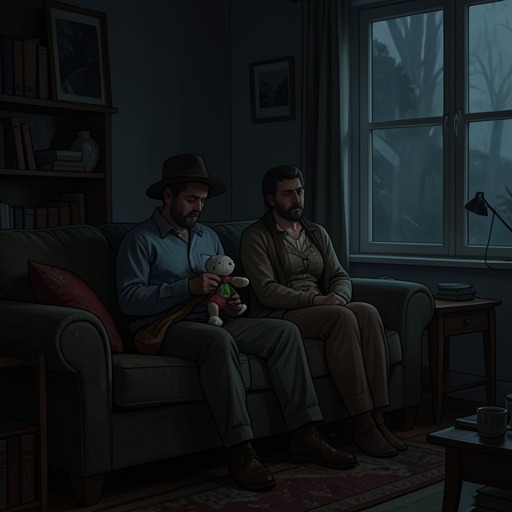
Peter Augustus Duchene's partnership with Leo Matienne
The Magician's ElephantPeter Augustus Duchene’s partnership with Leo Matienne turns a policeman’s defense of an unjustly accused animal into a personal alliance. Leo first argues that the elephant should not be punished for an accident she did not choose; later, he recognizes Peter’s desperate wish to see her and helps him imagine a way forward. Their bond takes shape through attention and trust: Leo makes room for Peter to tell his story, and Peter joins him in asking what might still be possible.
From public advocate to ally
Leo enters the story’s conflict as a policeman asked to help decide what should happen to the elephant after she crashes through the roof of the opera house and cripples a noblewoman. The chief of police, unable to find guidance in the handbook, solicits proposals from his subordinates. One officer suggests treating the elephant as a criminal simply because damage has occurred. Leo challenges that reasoning by separating the cause of the damage from the animal’s moral responsibility: if a magician threw a rock through a window, he argues, the rock would not be guilty of breaking it. His point is that the elephant did not choose to fall through the roof, and that an unwilling participant should not be treated as a culpable offender.
This intervention establishes the ethical basis of Leo’s later relationship with Peter. Leo is willing to question the official category applied to the elephant rather than accept punishment as an automatic consequence of harm. Yet his argument does not immediately give the animal control over what happens next. The Countess Quintet arranges a large door in her home, and the elephant is escorted there under cover of night. The door is locked behind her; the countess has paid for the opera-house repairs and now claims complete ownership. Against that change from police deliberation to private possession, Leo’s defense matters as a refusal to confuse power over an animal with a right to blame her.
Recognizing Peter’s need
Peter’s connection with the elephant begins before he meets Leo. At the market, he hears people describe a magician who was not expected to do anything special, then hears that no one expected an elephant. The impossible word arrests him because he is already thinking about his sister and the answers he has sought. This earlier scene helps clarify the urgency Leo later recognizes: Peter is not merely curious about a novelty in a countess’s ballroom. He wants very badly to see the elephant, and the wish is bound up with the questions and losses he carries.
Leo responds to that urgency with practical attention. After hearing news that gives him an idea, he thinks about how the countess might grow tired of owning an elephant. When he returns to the Apartments Polonaise, Peter is looking down from the attic window and asks whether Leo has worked out a way for the countess to receive him. Leo greets him warmly and immediately notices that Peter has lost his hat. The exchange makes their alliance personal: Leo has been trying to devise a route to the elephant, while Peter is willing to ask him directly for help. Leo does not promise that access is already secured; instead, his welcome signals that Peter’s request has become a problem they can consider together.
Listening before acting
The partnership deepens when Leo gives Peter the space to tell his story. After Peter has faced what he has lost and eaten, Leo sits beside him and asks him to explain everything from the beginning. The invitation matters because it puts listening before strategy. Leo does not reduce Peter to a petitioner who needs a favor, nor does he rush to supply an answer before understanding what the boy has experienced. His patient request makes Peter’s account part of the work they will do together.
That approach contrasts with the earlier public handling of the elephant, where officials search for a rule that can classify an extraordinary event. Peter’s story, by contrast, is not treated as a case to be disposed of. Leo offers time and attention, allowing the facts and their meaning to emerge through Peter’s telling. The relation is therefore more than a policeman’s assistance to a boy: it becomes a form of trust in which Peter is heard, and Leo’s practical efforts proceed from what Peter has actually said.
A shared possibility
The clearest expression of their partnership comes in a conversation at the Apartments Polonaise. Leo tips his chair back, and Gloria Matienne warns him that he is damaging it. He brings the chair down and raises the possibility that something might happen. When Gloria asks him not to start, Leo presses the thought further; a thump from above, where Vilna Lutz is demanding something with his wooden foot, interrupts them. Peter keeps his gaze on Leo and joins the exchange by asking whether the possibility might be real. Leo answers in the same spirit, while Gloria tries to end the speculation.
The moment does not amount to a completed plan or a guaranteed result. Its importance is that Peter is no longer asking Leo for access as a solitary supplicant: he participates in the hopeful reasoning Leo has already begun. Their repeated turns of possibility make uncertainty something they can share rather than something Peter must face alone. Leo’s earlier challenge to the police’s treatment of the elephant and his later effort to help Peter are connected by that willingness to resist a settled conclusion. He questions the claim that the animal must be guilty, imagines that the countess may relinquish her novelty, and invites Peter’s own hope into the discussion. The partnership is built not on certainty, but on Leo’s attention and Peter’s readiness to answer possibility with possibility.